
Technologies
EUREX ECO 1
EUREX ECO 1 is innovative pyrolysis system-technology of conversion from plastics to products.
It provides the technology of processing mixed plastic materials from municipal and industrial waste via the thermal processing of polymer waste without air access, which takes place continuously, while the main product is a continuously collected mixture of fission products in a gaseous state. These are subsequently condensed and obtained from them in distillation equipment liquid hydrocarbons that can be used as diesel and gasoline fractions.
It is therefore a chemical recycling of plastic waste, the output of which is obtaining a liquid mixture of hydrocarbons, which can be used as a raw material for the petrochemical industry or as a substitute for liquid fuels obtained by oil processing. It is not a process of incinerating plastic waste as a means to obtain energy.
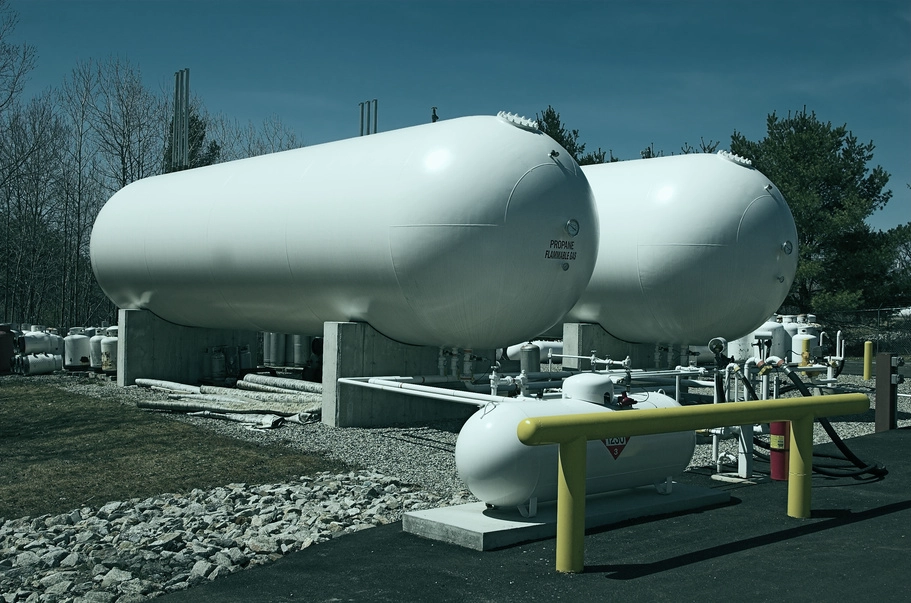
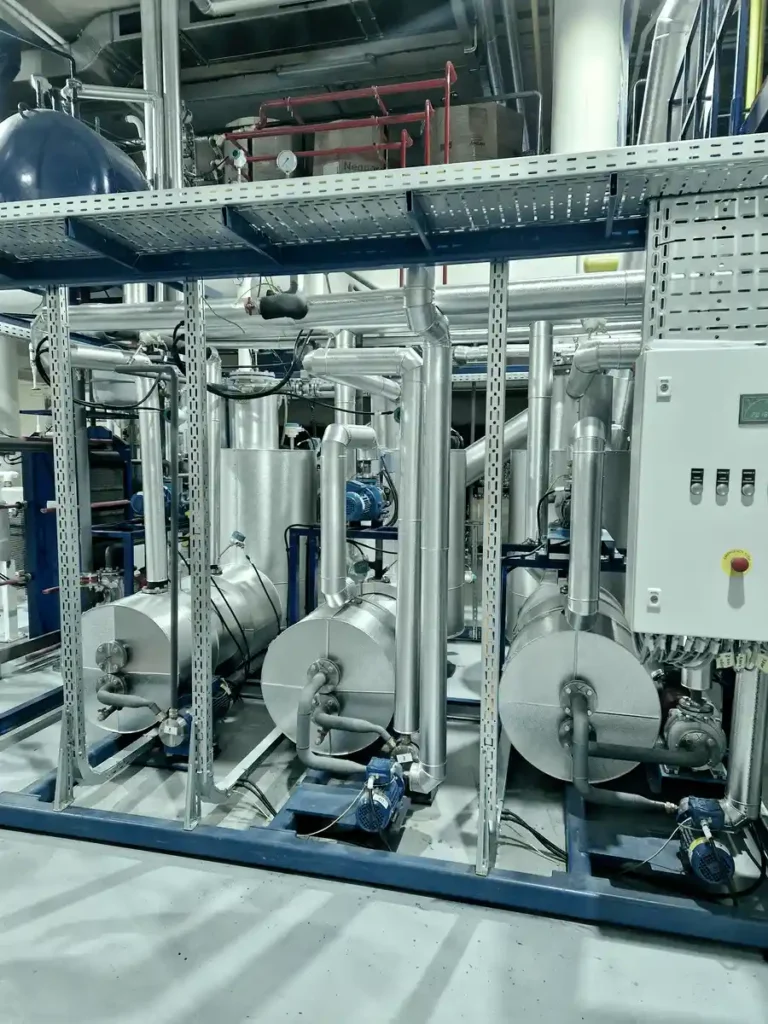
TECHNOLOGICAL PROCESS
The line is built on a unique three-phase process. In the first, mechanical-thermal phase, the incoming waste is suitably treated and freed from most of the water and other pollutants. The input can be all plastic waste based on PE and PP in any proportion, even with slight pollution up to 15% of the total weight. Plastics can come from both municipal and industrial waste, but also from landfills or other sources.
A melt is created from the input plastics, which in the second phase is decomposed in the reactor into process gas at a temperature of up to 430º C. This proceeds to the condensation system, where two liquid and one gas fractions are separated.
The resulting product can be certified secondary fuels suitable as a substitute for fuels from fossil sources, for example in electricity generators. After supplementing with absorbents, additional purification, and filtration, the output products can be used repeatedly for the production of plastics. And part of the non-condensable gases will be used as gaseous secondary fuel for the own process heating of the reactor of the recycling line.
The technological equipment does not have a significant impact on the environment from the point of view of emissions.

INPUTS
- Mixed municipal waste
- Mixed plastic waste
- Waste packaging material from industry and commerce (PE, PP, PS)
- Sorted plastic waste
- Plastic waste
OUTPUT PRODUCTS
- Liquid: medium fraction (diesel), light fraction (gasoline)
- Gaseous: technological gas
- Solid residue
Example technical parameters, they can be modified.
| Operation | ||||
|---|---|---|---|---|
| Number of operation hours | 7 200 | year | 7 200 | year |
| Input | ||||
| Amount of mixed plastic waste | 400 | kg/hr | 880 | pound/hr |
| 2 880 000 | kg/year | 6 350 000 | pound/year | |
| Outputs | ||||
| Middle fraction | 250 | l/hr | 66 | gallon/hr |
| 1 800 000 | l/year | 475 510 | gallon/year | |
| Light fraction | 50 | l/hr | 15 | gallon/hr |
| 360 000 | l/year | 95 100 | gallon/year | |
| Recyclable (middle + light fraction) | 300 | l/hr | 81 | gallon/hr |
| 2 160 000 | l/year | 571 000 | gallon/year | |
| Technological gas | 28 | m³/hr | 28 000 | liter/hr |
| 201 600 | m³/year | 201 600 000 | liter/year | |
| Solid residues (approx. 5% from input volume) | 20 | kg/hr | 44 | pound/hr |
| 144 000 | kg/year | 317 470 | pound/year | |
MAIN ADVANTAGES
- Use of the process of thermal degradation of polymers, during which decomposition occurs without access to oxygen which means that it is not a combustion technology
- Very low consumption of external energy – the produced technological gas is also used to heat the main reactor itself
- Compactness – the unit can be installed in a small space and at the same time it can be dismantled and moved to any place
- Continuous production process – high capacity and energy output, high efficiency of the equipment
- Quality output product – easy placement on the market
- High level of automation – low requirements for manual operation